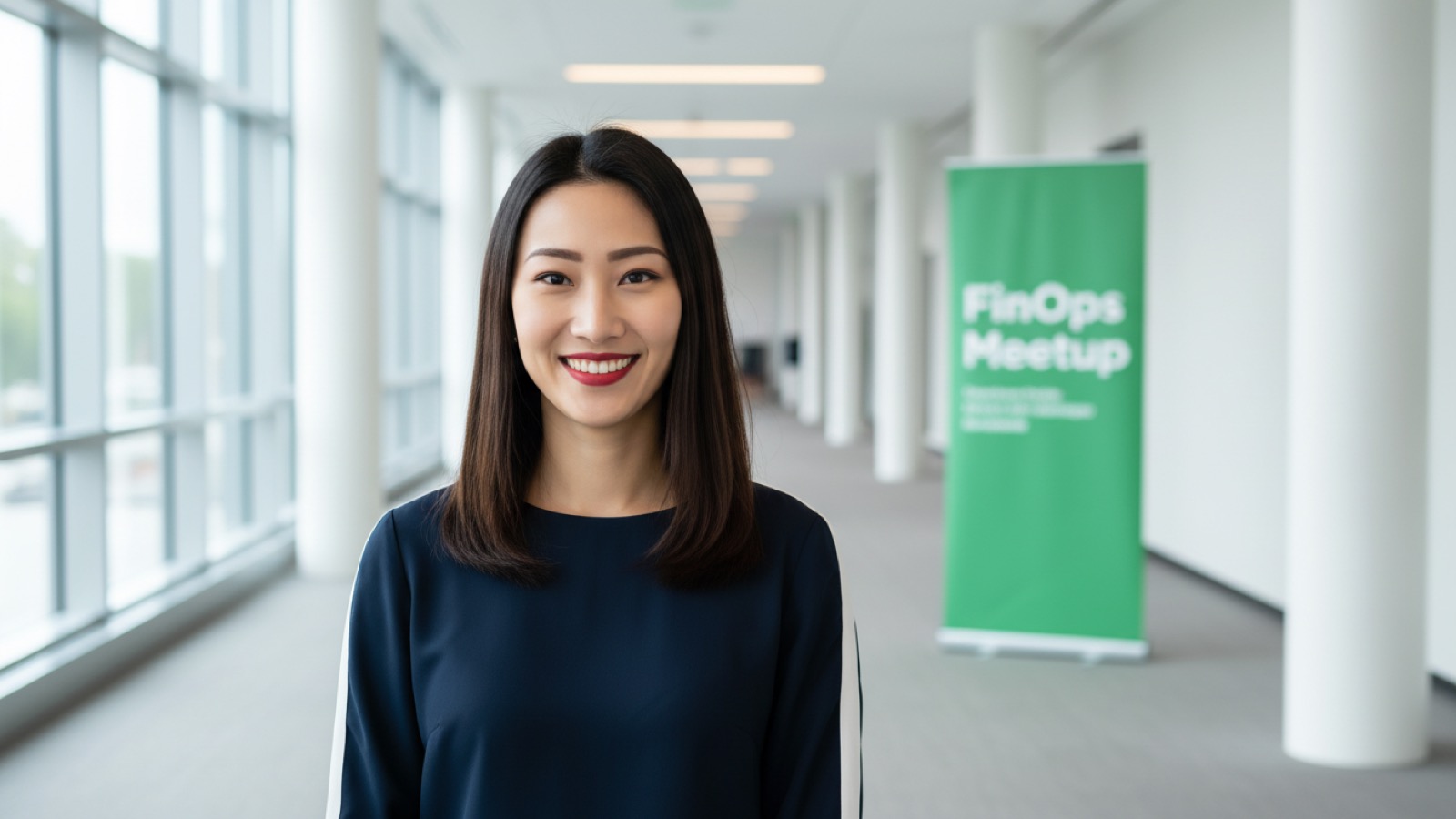
Hayley Kozak is a FinOps practitioner with over six years of experience across enterprise, hyperscaler, and consulting environments. She spent three and a half years on the AWS OPTICS team helping strategic customers achieve cloud efficiency and is a founding organizer of the DFW FinOps meetup group. She is an active contributor to the FinOps Foundation community.
Hayley Kozak didn't plan a career in FinOps. She immigrated from China to the United States in 2016. It was the kind of leap, she'll tell you, that isn't so different from the bungee jumping and tandem skydiving she counts among her favourite pursuits. You commit, you jump, and you figure out the landing. Once she "touched-down" in the States and earned a degree in IT, she joined Experian's global rotation program with more curiosity than direction, and cycled through cybersecurity, networking, data platforms, and IT finance, and then checked-in on the cloud engineering team. Her manager handed her a bill. That was 2018, and the rest is FinOps history.
What followed was a career that took her through Spot by NetApp, 3M Healthcare, and three and a half years at AWS on the OPTICS team, a specialized group embedded alongside account teams to help strategic enterprise customers unlock cloud efficiency. Earlier this year, Hayley was caught in the wave of AWS layoffs that reshaped teams across the industry. She is candid about it, and characteristically constructive. Rather than retreat, she leaned into the one constant that has anchored every chapter of her career: the FinOps community.
"Even if I don't continue to work in the field, I would still love to be part of the FinOps community and contribute to it. All of us are doing this voluntarily, and it's been really nice to just build that network and learn from each other."
Getting Started: A Bill, a Community, and a Career Path

Community is where Hayley's FinOps journey began, and where it keeps returning.
Q: You came into FinOps without knowing what it was. What made you stay?
I was new to everything: AWS, GCP, Azure, Oracle. But FinOps was booming at exactly that time. The FinOps Foundation was just getting started and I really learned a lot from the community. That's why I love it so much. It was never just a job function. It felt like a field that was building itself in real time, and I wanted to be part of that.
Q: Your subsequent roles (Spot by NetApp, 3M Healthcare, then AWS) all came to you rather than the other way around. What do you attribute that to?
LinkedIn was a big part of it. But more than that, I think it's the FinOps community itself. It's a small world. When you contribute (when you show up, share what you know, and engage with others), people notice. I would highly recommend to anyone new to FinOps: join communities, contribute to it, and don't be shy about sharing what you've learned. That visibility compounds over time.
Building Local Roots: The DFW FinOps Meetup
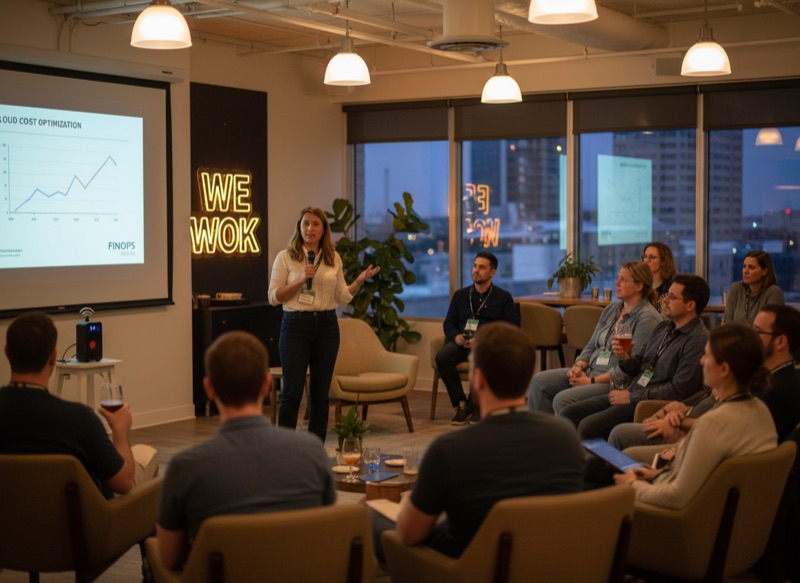
The DFW meetup gives practitioners a safe stage to develop their voices.
Q: You've done more than participate in the FinOps community. You've actively built it in the Dallas-Fort Worth area. Tell us about the DFW FinOps meetup.
When I came back from maternity leave in 2025, I felt this real pull to do more. There had been one in-person FinOps meetup per year in our area, and I thought: we can do better than that. So a small planning committee of us started organizing quarterly meetups. For Q1, AWS sponsored it. From Q2 onward, we brought in FinOps vendors as sponsors. Each quarter has its own format: sometimes a formal speaking program with two or three presentations, sometimes a happy hour and networking, and for Q4, an end-of-year gathering. We try to match the format to what the community needs most.
Q: How do you decide what topics to cover?
It starts with listening. After Q1 of last year, the feedback was clear: people wanted to hear about FinOps culture and unit economics. So Q2 was themed entirely around unit economics, with practitioners presenting their own experiences. Q3 fell right after FinOps X, so we did a recap: announcements, trends, panel discussions on what people brought back from the conference. This year we're planning to replicate that format again. It evolves with the community.
Q: There's also a deliberate focus on developing speakers within the group?
Yes, and that's something I care about deeply. Public speaking is intimidating for a lot of people. The meetup gives practitioners a safe environment to try it: a friendly audience, a relevant topic, low stakes. Several members who had never spoken publicly before have now presented at our meetups. It's one of my favorite things we've built into the format.
"It only works when it's ingrained in everybody's mind. Just as we talk about security being everyone's job, FinOps is the same way."
Starting with the Right Question: KPIs Before Dashboards

Start with the goal. The dashboard is the last thing to build.
Q: You've helped enterprise customers at various stages of FinOps maturity. Where do most organizations go wrong at the start?
The most common mistake is starting with the dashboard instead of starting with the goal. Everyone knows the crawl-walk-run framework, and teams will dive straight into building cost visibility and running optimization sprints, without ever asking: why are we doing this? What will we do with the money we save? How does our cloud spend connect to the value we deliver as a business? You can execute every phase correctly and still end up optimizing toward no particular destination. Set the goal first.
Q: How do you structure KPIs when you're working with a customer from scratch?
I always recommend two tracks. The first is cloud efficiency KPIs: resource utilization rate, commitment coverage and utilization rate, S3 lifecycle policy coverage rate for example. These are your operational health metrics. The second, and more important track, is business value KPIs: cost per transaction, cost per user, margin impact. The challenge is that most customers find this second track significantly harder to build. It requires conversations with business teams that the FinOps team has often never had. But those are exactly the conversations that elevate FinOps from a cost-cutting exercise to a strategic function.
The Variable That Changes Everything: Executive Sponsorship

Executive sponsorship is the single variable that moves FinOps from program to practice.
Q: In your time at AWS OPTICS, working across dozens of enterprise accounts, what most separated the organizations that made FinOps truly work?
Executive sponsorship. Full stop. I've seen customers fly team members in from multiple countries, across multiple time zones, just to attend a FinOps workshop we hosted. That kind of investment doesn't happen without a leader who genuinely understands what FinOps means for the business. When you have a senior sponsor who can get finance and engineering in the same room, who is willing to put real resources behind the practice, the whole program moves differently. And it shows up in the results.
Q: FinOps is inherently cross-functional. How should different stakeholders think about their role in it?
Everyone has to care, but in a different way. For engineers, it's about building with cost awareness baked into the architecture from day one. For product owners, it's about understanding how their features translate to spend. For senior leadership, it's about margin impact and business value. The KPIs are different at each level, but the underlying question is the same: how much does this cost, and what are we getting for it? When everyone is asking that question through their own lens, FinOps becomes a culture rather than a program.
Navigating a Layoff: A Practitioner's Perspective

A pause, not an ending. The community turns transition into momentum.
Q: You were part of the AWS layoffs earlier this year, and you're not alone. A significant number of FinOps practitioners embedded at hyperscalers have been impacted. How are you approaching this chapter?
It's the first layoff of my career, so I didn't quite know what to expect. But I think it's actually a good moment to pause and reflect, to ask what I've learned, what I want to do next, and what kind of impact I want to have. I'm looking at three paths within FinOps: a consulting role similar to what I did at AWS, an enterprise-side position where I can either join or build a FinOps team, or a role on the vendor and partner side. But I'm also keeping an open mind beyond FinOps as AI starts to reshape what skills are valuable.
Q: What would you say to other practitioners who find themselves navigating a similar transition?
Don't limit yourself. Use AI as a tool. It's genuinely useful for job searching, interview prep, and staying current. But invest in your network, and specifically in the community. Every interview I've gotten has come through a referral or a direct connection, not through a cold application. The community is not just where you learn FinOps. It's where you find your next opportunity.
"Don't limit yourself. There are so many opportunities out there. The community is not just where you learn — it's where you find your next opportunity."
AI and FinOps: Accelerator, Not Replacement

AI agents clear the routine, freeing practitioners for the judgment calls.
Q: How do you see AI changing the day-to-day practice of FinOps?
I'm optimistic about it. The most exciting development I've seen is AI agents built internally to answer cost optimization questions on demand. Imagine an engineer who wants to understand Graviton pricing. Instead of waiting for the FinOps team, they query an internal agent and get the answer immediately. The AWS console is already moving in this direction with built-in AI for cost analysis. All of this removes routine, lower-value analysis work, and that's a good thing. It frees the FinOps team to focus on what actually requires judgment: connecting the business to engineering, building the roadmap, having the hard conversations.
Q: And what about the flip side: FinOps for AI, and the challenge of governing AI spend?
That's probably the hardest question in the field right now. Most senior leaders are still trying to figure out what their ROI on AI investment looks like. But this is precisely where FinOps has a critical role to play. The discipline is perfectly designed to ask that question rigorously. In the near term, I think the most immediate contribution FinOps practitioners can make is governance: helping organizations decide which models to use, what guardrails to put around GPU provisioning, and how to prevent an uncontrolled sprawl of AI spend. The ROI question will eventually be answered, but not without the frameworks FinOps already provides.
The Next Frontier: Where FinOps Goes from Here

The frontier is AI infrastructure and unit economics at scale.
Q: Where do you see FinOps heading over the next three to five years?
A few directions. The most immediate is AI infrastructure. FinOps is expanding to cover the cost and governance of AI factories, not just cloud. The FinOps Foundation is already signalling this by broadening its scope. The second direction is unit economics at scale. Connecting cloud spend to granular business value remains one of the hardest unsolved problems in the field. While some platforms are starting to address this, I haven't yet seen a solution that seamlessly ties infrastructure spend to business outcomes in a way that's truly operational for both FinOps teams and business stakeholders without significant custom data modeling. Whoever solves that problem will have a significant market.
Q: Any advice for early-career practitioners who want to be well-positioned for where the field is heading?
Learn how AI works, not just AI for FinOps, but how to build agents, how to work with models, how governance applies to AI spend. That skill set will be relevant regardless of which direction the field evolves. And keep contributing to the community. FinOps is still young enough that the people building it are accessible, generous with their knowledge, and genuinely invested in helping each other succeed. Take advantage of that.
About Hayley Kozak
Hayley Kozak is a FinOps practitioner with over six years of experience across enterprise, hyperscaler, and consulting environments. She spent three and a half years on the AWS OPTICS team helping strategic customers achieve cloud efficiency and is a founding organizer of the DFW FinOps meetup group. She is an active contributor to the FinOps Foundation community. Connect with Hayley on LinkedIn.